
Short answer
Discover why payment visibility and reconciliation matter for fintech companies and how better transaction tracking helps improve financial accuracy and operations.
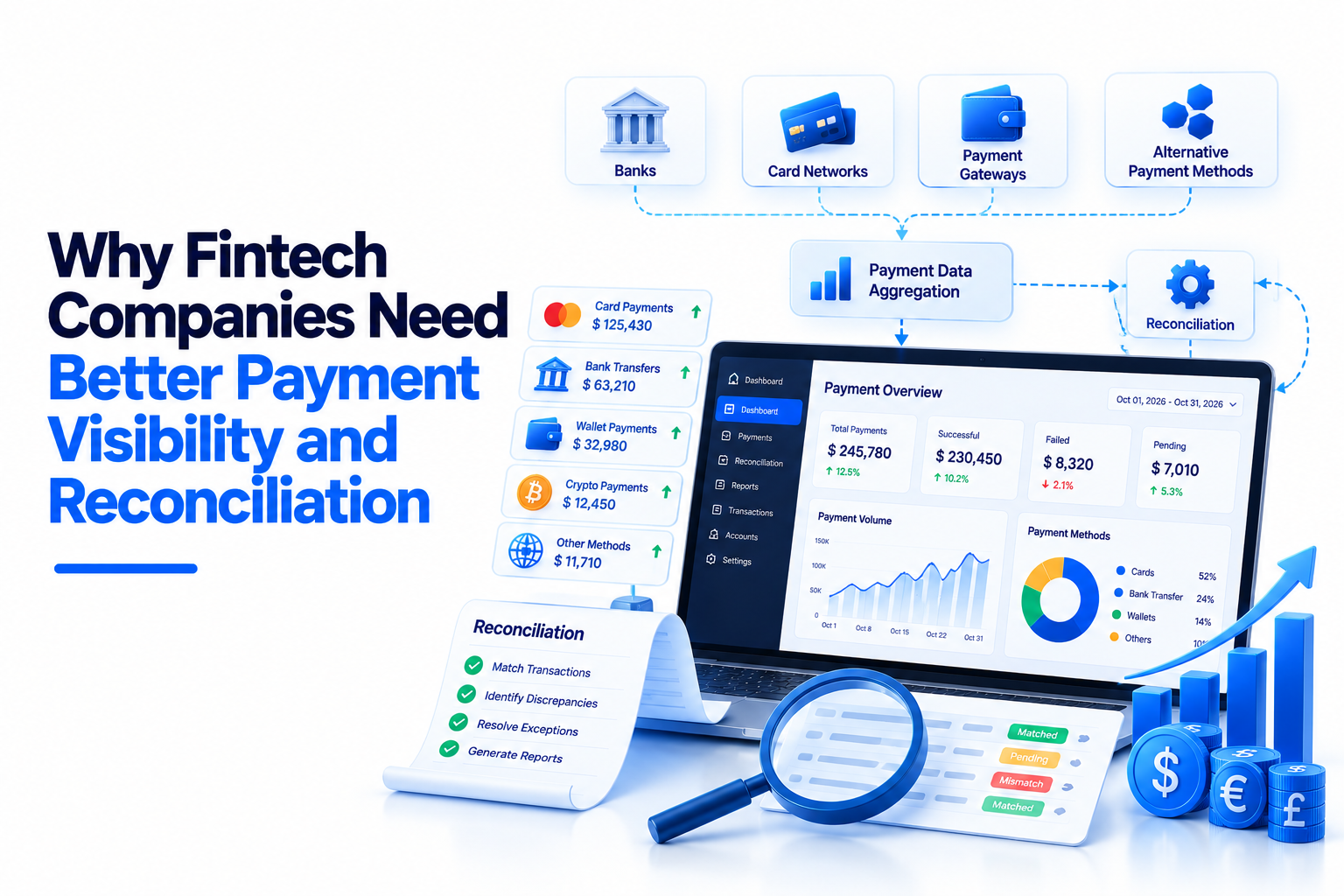
Fintech companies manage multiple financial activities every day, including card transactions, customer payments, account movements, and payouts. As businesses grow, tracking these activities across different platforms becomes increasingly complex. This is why payment visibility for fintech companies is essential for maintaining accurate records, understanding transaction statuses, and managing financial operations effectively. With the right fintech payment infrastructure, businesses can connect relevant payment systems, monitor transactions, and improve access to financial information. Better visibility and reconciliation help fintech companies identify payment issues, reduce manual work, and maintain greater control over their payment operations.
What Is Payment Visibility?
Payment visibility refers to the ability to track and understand payment activity across connected systems. It helps businesses access important transaction details, including payment status, processing updates, settlement information, and payout progress. For example, a fintech platform may need to determine whether a payment was completed, remains pending, or failed during processing. When information is spread across multiple providers and dashboards, finding the correct status can take time. Effective payment transaction tracking brings relevant information into a clearer view. It also supports transaction monitoring, helping finance and operations teams investigate issues, respond to customer queries, and understand how money moves through their payment ecosystem.
What Is the Payment Reconciliation Process?
The payment reconciliation process involves comparing internal transaction records with external financial records from banks, payment providers, card processors, or other relevant systems. The objective is to confirm that transaction amounts, fees, refunds, and settlements match the expected records. If differences appear, businesses can investigate missing transactions, duplicate entries, processing delays, or other discrepancies. Financial reconciliation is particularly important for fintech companies handling high transaction volumes. An effective process helps maintain accurate financial records, supports reliable reporting, and makes it easier to identify unresolved payment issues.
Why Payment Visibility and Reconciliation Matter for Fintech Companies
1. Better Transaction Tracking
Clear payment information helps businesses understand what is happening at each stage of a transaction. Effective payment transaction tracking enables teams to identify pending payments, monitor payout progress, and investigate failed transactions without relying entirely on manual checks.
2. Faster Identification of Discrepancies
Payment discrepancy management helps businesses identify and investigate differences between internal records and external statements. By establishing clear procedures for reviewing unmatched transactions, companies can resolve issues more efficiently and reduce the risk of accumulating accounting errors.
3. Improved Financial Accuracy
Accurate transaction records are essential for financial planning, reporting, and day-to-day operations. Regular financial reconciliation helps fintech businesses verify payment amounts, account for applicable fees, and understand settlement differences.
4. More Efficient Payment Operations
Effective payment operations management helps teams coordinate transaction monitoring, payment processing, settlement checks, and issue resolution. Automation and connected systems can reduce repetitive tasks and allow staff to focus on exceptions that require attention.
5. Clearer Payment Reporting
Reliable payment reporting helps businesses review transaction activity, identify operational patterns, and understand payment performance. When relevant information is accessible in a consistent format, teams can make better-informed decisions and investigate problems more easily.
Common Challenges in Payment Visibility and Reconciliation
Fintech companies may face several challenges as their operations expand. These include fragmented transaction data, inconsistent payment references, different settlement timelines, currency conversion differences, and limited access to consolidated reports. High transaction volumes can make these challenges more difficult to manage. Manual spreadsheets and disconnected dashboards may also increase the time required to identify discrepancies. To address these issues, businesses should establish consistent transaction identifiers, maintain reliable records, connect relevant applications through APIs where available, and define clear procedures for investigating unmatched transactions. Implementing automated payment reconciliation can help compare records, match transactions, and flag potential discrepancies for further investigation. Although automation can reduce manual effort, accurate results still depend on reliable source data and well-defined reconciliation rules.
The Role of Connected Payment Systems and Card Issuing Infrastructure
Modern fintech businesses often manage multiple financial services, including payment processing, card programs, accounts, and payouts. Connected payment systems help bring these activities together by enabling relevant applications to exchange information and support more consistent operational workflows. For businesses offering payment cards, card issuing infrastructure is another important component. It supports the technology and operational processes required to manage card programs, transactions, and related payment activities. A Card Issuing API can help businesses integrate card-related capabilities into their own platforms. Depending on the provider's features, APIs may support card creation, card status management, transaction data access, and other issuing workflows. When these capabilities are connected with broader payment systems, businesses can work toward better transaction visibility and more organized financial operations.
How NetPay Supports Connected Payment Operations
For growing fintech companies, effective payment visibility depends partly on how well their financial systems and workflows connect. NetPay provides payment infrastructure for businesses exploring connected card and payment capabilities, including card issuing infrastructure, virtual IBANs, multi-currency accounts, payments, payouts, and API-based integrations. Through its broader NetPay payment infrastructure, businesses can explore ways to connect relevant payment capabilities with their operational systems. Depending on the selected solution, API integrations can help businesses exchange information between applications and support more organized transaction workflows. Businesses should evaluate their reporting, reconciliation, card issuing, and integration requirements when selecting a payment infrastructure provider. The specific features, API endpoints, transaction events, and integrations available should be confirmed for the chosen NetPay solution.
Conclusion
Payment visibility and reconciliation are essential for fintech companies that want to manage transactions accurately and maintain control over their financial operations. Visibility helps teams understand payment activity, while reconciliation helps verify that financial records match relevant external data. By improving payment visibility for fintech companies, strengthening payment operations management, and adopting automated payment reconciliation where appropriate, businesses can reduce repetitive work and investigate discrepancies more effectively. With suitable fintech payment infrastructure and well-connected workflows, businesses can build a more organized financial ecosystem. NetPay supports businesses exploring connected payment capabilities as they work toward more efficient and manageable payment operations.
Why is payment reconciliation important for fintech companies?
Payment reconciliation helps businesses compare internal transaction records with external financial records, identify discrepancies, and maintain more accurate reporting.
What are the common challenges in payment reconciliation?
Common challenges include missing transaction records, duplicate entries, settlement delays, processing fees, currency differences, and disconnected payment systems.
How can fintech companies improve payment visibility?
Businesses can improve visibility by connecting relevant systems, standardizing transaction references, using clear reporting dashboards, and monitoring transaction status updates.
Can payment reconciliation be automated?
Yes. Software and integrations can compare transaction records, match corresponding entries, and flag discrepancies. However, exceptions may still require investigation and manual review.
How does NetPay relate to payment visibility?
NetPay provides payment infrastructure and API-based integration capabilities for businesses. Depending on the selected solution, these capabilities can support connected payment workflows and transaction information management.

The NetPay247 team writes about card issuing, Virtual IBANs, cross-border payments and building products on embedded finance infrastructure.

Leave a reply
Your email address will not be published. Required fields are marked *