
Short answer
Discover how stablecoin payments move from wallet deposits to business balances, including blockchain confirmation, payment verification, compliance checks, and reconciliation.
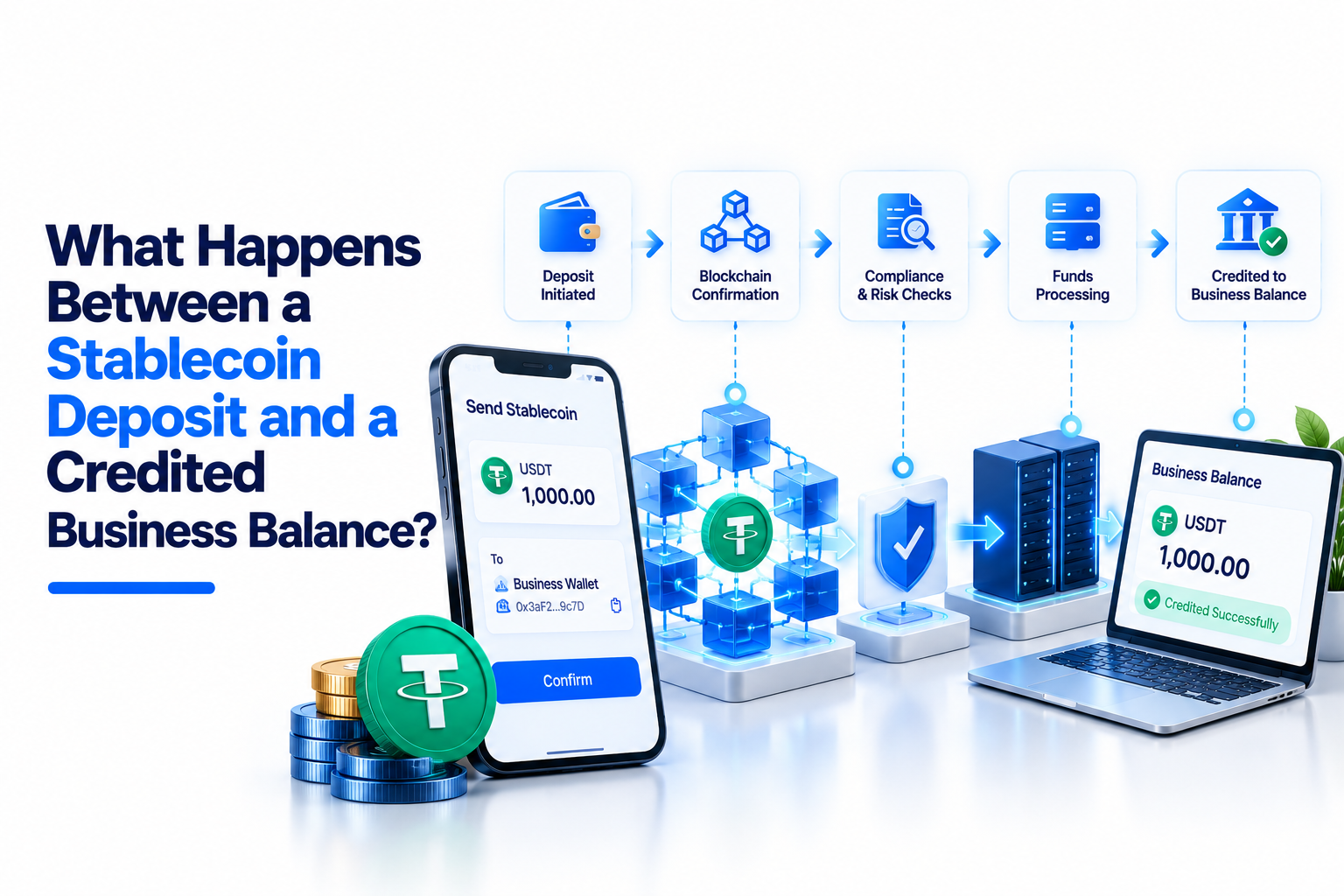
Stablecoins are becoming an important part of digital payments because they combine blockchain-based transfers with a value designed to remain relatively stable against a reference currency, such as the US dollar. For businesses accepting USDT or USDC, receiving funds may appear as simple as sharing a wallet address. However, there are several steps between a customer sending a stablecoin and a business seeing the funds reflected in its available balance. Understanding this process helps businesses improve payment visibility, manage settlement expectations, and maintain accurate financial records. It also highlights why reliable stablecoin payment processing requires more than simply receiving a blockchain transaction.
1. The Customer Initiates the Stablecoin Transfer
The process begins when a customer or business sends stablecoins from a wallet or exchange to a designated receiving address. At this stage, the sender must use the correct wallet address, blockchain network, and supported asset. For example, USDT can exist on multiple networks, and a receiving platform may support only selected networks. If the sender chooses an unsupported network or enters an incorrect address, the funds may not arrive as expected. Businesses should therefore provide clear payment instructions and explain which assets and networks they accept. A well-designed stablecoin payment infrastructure helps organize these payment details and reduces confusion during the deposit process.
2. The Transaction Is Broadcast to the Blockchain
After the transfer is submitted, the transaction is broadcast to the relevant blockchain network. The transaction may become visible on a blockchain explorer before it is considered sufficiently confirmed for the receiving platform's purposes. During this stage, the network processes the transaction and validators or miners help establish its inclusion in the blockchain, depending on the network's consensus mechanism. The time required can vary based on network conditions, fees, congestion, and the blockchain being used. This means a transaction that has been submitted is not necessarily ready to be credited to a business account immediately. For businesses, monitoring transaction status is an important part of providing a clear and reliable payment experience.
3. The Receiving Platform Verifies the Deposit
Once the transaction appears on the network, the receiving platform needs to verify that it meets the required conditions. These checks may include: Confirming that the transaction involves a supported stablecoin. Verifying the receiving address and blockchain network. Checking the transferred amount and transaction status. Waiting for the required number of confirmations. Applying relevant compliance and risk checks. The number of confirmations required depends on the network, transaction value, platform policies, and risk model. A transaction may be visible on-chain but remain pending until the platform's acceptance criteria are satisfied. For businesses operating across markets, payment automation and clear transaction-status tracking can help make this process easier to monitor.
4. Compliance Checks May Affect When Funds Become Available
Blockchain confirmation is only one part of the deposit process. Depending on the provider, transaction, and applicable requirements, additional screening may be necessary before funds become available. These checks can include wallet risk screening, sanctions screening, customer verification, and transaction monitoring. If a transaction requires further review, the credited balance may be delayed even after the blockchain transfer has been confirmed. This is why businesses should distinguish between a transaction being received, a deposit being confirmed, and funds being available for use. A transparent payment workflow should communicate these different statuses clearly rather than treating every incoming transfer as immediately spendable.
5. The Business Balance Is Updated
After the required verification and processing steps are complete, the platform can record the deposit and update the relevant business balance. Depending on the service, the balance may remain in the original stablecoin or be converted into another supported currency. If conversion takes place, the applicable exchange rate, fees, and conversion timing can affect the final amount credited. The platform should maintain a clear link between the blockchain transaction and the internal ledger entry. This makes it easier for finance teams to verify incoming funds and investigate discrepancies. Reliable payment reconciliation helps businesses compare on-chain activity with their internal records, identify unmatched transactions, and maintain accurate reporting.
How NetPay Fits Into Stablecoin Payment Infrastructure
NetPay supports stablecoin payments, including USDT and USDC, as part of its broader digital payment infrastructure. For businesses exploring stablecoin-based payment flows, the important consideration is how incoming digital payments fit into the wider payment operation. Alongside stablecoin payment capabilities, NetPay offers global payments, multi-currency payment infrastructure, payment APIs, and payment orchestration. These capabilities support businesses that need to connect different payment methods and manage payment activity through a more unified system. When evaluating a stablecoin payment solution, businesses should confirm the supported blockchain networks, deposit confirmation policies, compliance requirements, settlement arrangements, conversion options, and reconciliation features. These details determine how a stablecoin transfer moves from the sender's wallet to a usable business balance.
Conclusion
A stablecoin deposit involves several steps before the funds become available to a business. The transaction must be submitted to the blockchain, confirmed according to the receiving platform's requirements, verified, and recorded in the business's financial system. Depending on the transaction and provider, compliance checks or currency conversion may add further steps. By understanding this journey, businesses can set clearer payment expectations, improve stablecoin payment processing, and maintain more accurate financial records. As digital payments continue to evolve, reliable payment infrastructure will be essential for connecting blockchain-based transfers with everyday business operations.
How long does it take for a stablecoin deposit to be credited?
The timing depends on the blockchain network, network conditions, required confirmations, and the receiving platform's verification process. Some deposits may be processed quickly, while others may require additional time.
Why is my stablecoin transaction confirmed but not credited?
The platform may require additional confirmations, network or asset verification, compliance screening, or internal processing before updating the available balance. Contact the provider if the deposit remains pending beyond its stated processing time.
Does a confirmed blockchain transaction mean the money is available to spend?
Not necessarily. Blockchain confirmation establishes the transaction's status on the network, while the receiving platform may apply further verification and processing before making the funds available.
What is stablecoin payment reconciliation?
Stablecoin payment reconciliation is the process of matching blockchain transactions with internal payment records and business ledger entries. It helps identify missing records, incorrect amounts, and unmatched deposits.
How can businesses make stablecoin deposits easier to manage?
Businesses can provide clear deposit instructions, monitor transaction statuses, apply suitable verification procedures, maintain accurate ledger records, and use payment infrastructure that supports automated tracking and reconciliation.

The NetPay247 team writes about card issuing, Virtual IBANs, cross-border payments and building products on embedded finance infrastructure.

Leave a reply
Your email address will not be published. Required fields are marked *