
Short answer
Explore the key payment challenges crypto businesses face when expanding internationally, including FX, cross-border payments, compliance, and reconciliation.
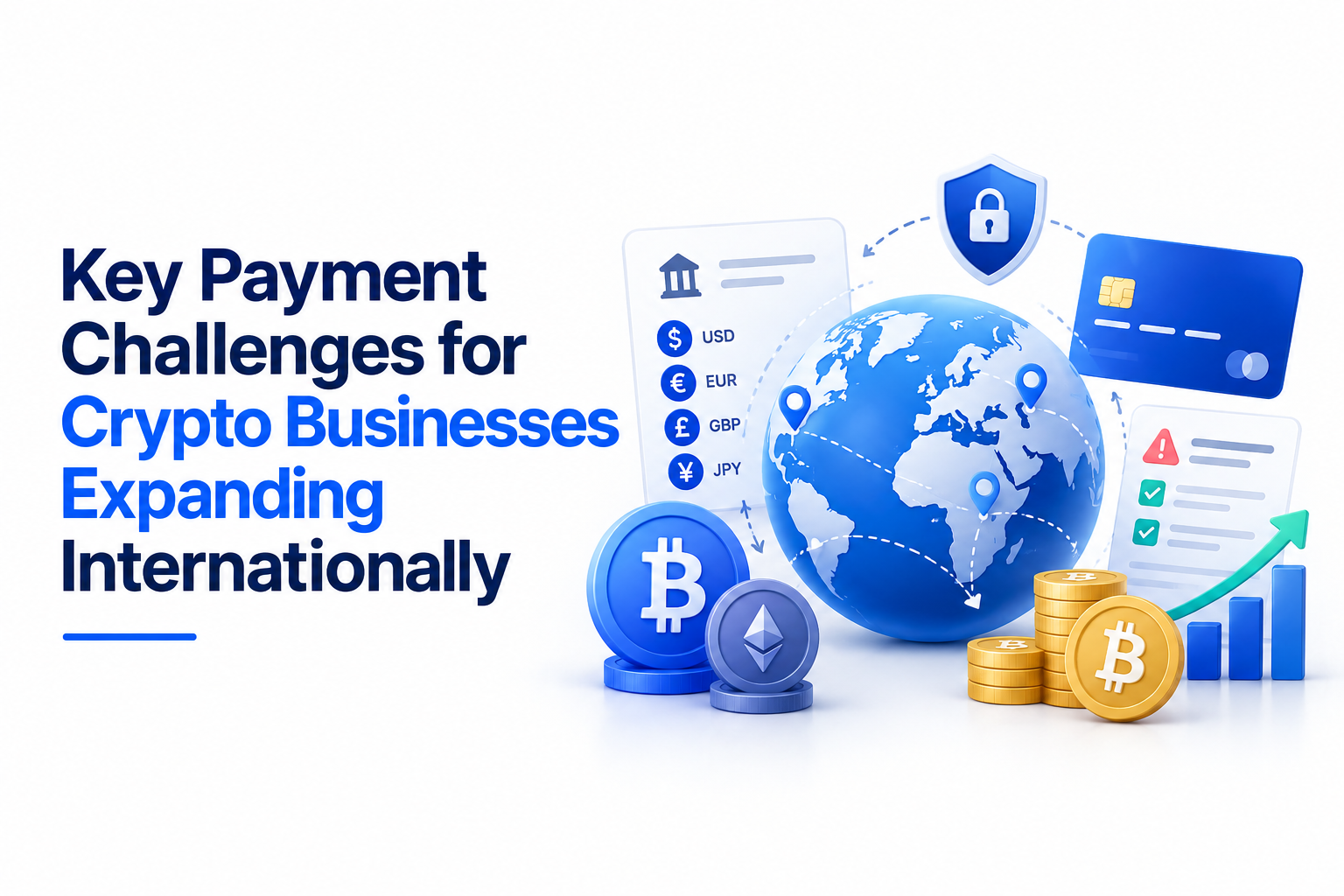
Crypto businesses are increasingly operating across multiple markets, serving international customers, partners, merchants, and platforms. While digital assets can move across borders quickly, the underlying payment infrastructure can be much more complex. As a crypto business expands internationally, it may need to manage multiple currencies, payment methods, banking relationships, compliance requirements, settlements, and transaction records. This makes choosing the right payment infrastructure for crypto businesses an important part of international growth.
Managing Multiple Currencies
One of the first challenges is managing different currencies. A crypto business may receive funds in one currency, convert them into another, and eventually settle with a customer, merchant, or partner in a different currency. This can create additional operational steps around FX conversion, multi-currency payments, and settlement. A connected payment infrastructure can help bring these processes into a more unified workflow instead of requiring businesses to manage currency conversion separately from the payment journey.
Cross-Border Payment Complexity
International payments can involve different payment rails, processing requirements, currencies, and settlement timelines. A crypto business serving customers across several countries therefore needs infrastructure that can support international payment flows while providing visibility into transaction status. The challenge is not simply moving money from one country to another. Businesses also need to know where the transaction is, whether it has been completed, and how it should be recorded internally.
Fiat and Digital Asset Operations
Crypto businesses may operate at the intersection of digital assets and traditional financial systems. This can create additional complexity when customers need to move between crypto-related services and fiat payment channels. Depending on the business model and applicable regulations, payment infrastructure may need to support different transaction flows while maintaining clear records and appropriate controls. The important requirement is to keep the payment journey connected rather than allowing different financial processes to become isolated systems.
Compliance and Transaction Monitoring
International expansion also increases the importance of compliance. Businesses operating across jurisdictions may face different requirements related to customer verification, transaction monitoring, sanctions screening, and other financial controls. Payment infrastructure should therefore provide appropriate visibility and control over transactions. For crypto businesses, maintaining accurate transaction information can be particularly important when dealing with higher transaction volumes and multiple markets.
Payment Failures and Operational Delays
A cross-border payment does not always complete successfully. Transactions may fail because of incorrect payment information, insufficient funds, processing issues, compliance checks, currency-related problems, or other factors. When payments fail, businesses need to identify the reason, update the relevant systems, and determine whether the transaction can be corrected or retried. Without connected infrastructure, resolving these issues can involve several systems and manual processes.
Reconciliation Across Multiple Systems
Reconciliation can become another major challenge as a crypto business grows internationally. Finance and operations teams may need to match payment records with settlement information, fees, currency conversions, refunds, and internal transaction records. A connected payment reconciliation process can help businesses maintain a clearer record of the full transaction lifecycle. This becomes increasingly important when payments are processed across different currencies and markets.
Connecting Payment Infrastructure With Business Systems
International crypto businesses often rely on several technology systems, including customer platforms, wallets, accounting tools, compliance systems, payment providers, and internal dashboards. APIs and webhooks can help these systems communicate. For example: Payment Initiated → Transaction Processed → Webhook → Internal System Updated This can reduce manual data movement and help businesses maintain more current payment information.
How NetPay Can Support International Payment Operations
NetPay provides global payment infrastructure designed to help businesses manage connected payment workflows. Its capabilities cover areas such as global payments, FX conversion, payment routing, delivery, webhooks, reconciliation, and card-related infrastructure. For crypto businesses expanding internationally, this type of connected infrastructure can help simplify the operational side of moving money across markets. Instead of treating payment processing, FX, transaction data, and reconciliation as separate activities, businesses can build a more unified payment workflow around their international operations.
Final Thoughts
International growth creates significant opportunities for crypto businesses, but payments can become increasingly complex as the number of markets, currencies, transactions, and financial workflows increases. Common challenges include: Multi-currency payments FX conversion Cross-border payment routing Compliance and monitoring Payment failures Settlement Reconciliation System integration A connected payment infrastructure can help businesses manage these challenges more efficiently. For crypto businesses looking beyond their domestic market, the goal should not simply be to move money internationally. It should be to build payment infrastructure that can connect, monitor, automate, and reconcile the entire transaction journey. NetPay provides infrastructure designed to help businesses build and manage these connected global payment workflows as they expand across markets.
What are the main payment challenges for crypto businesses expanding internationally?
Common challenges include managing multiple currencies, FX conversion, cross-border payment routing, compliance requirements, payment failures, settlement, reconciliation, and integrating multiple financial systems.
Why is payment infrastructure important for crypto businesses?
Payment infrastructure helps connect payment processing, transaction data, FX, routing, settlement, and reconciliation into more organized workflows.
How does FX affect international crypto businesses?
Businesses operating across markets may need to convert between currencies when receiving, sending, or settling payments. Integrated FX can help make this part of the broader payment flow.
Why is reconciliation important for international crypto payments?
Reconciliation helps businesses match transactions with settlement records, fees, currency conversions, refunds, and internal financial records.

The NetPay247 team writes about card issuing, Virtual IBANs, cross-border payments and building products on embedded finance infrastructure.


Leave a reply
Your email address will not be published. Required fields are marked *