
Short answer
Understand payment infrastructure vs payment APIs, how they differ, and how businesses can connect payments, payouts, accounts, and card services.
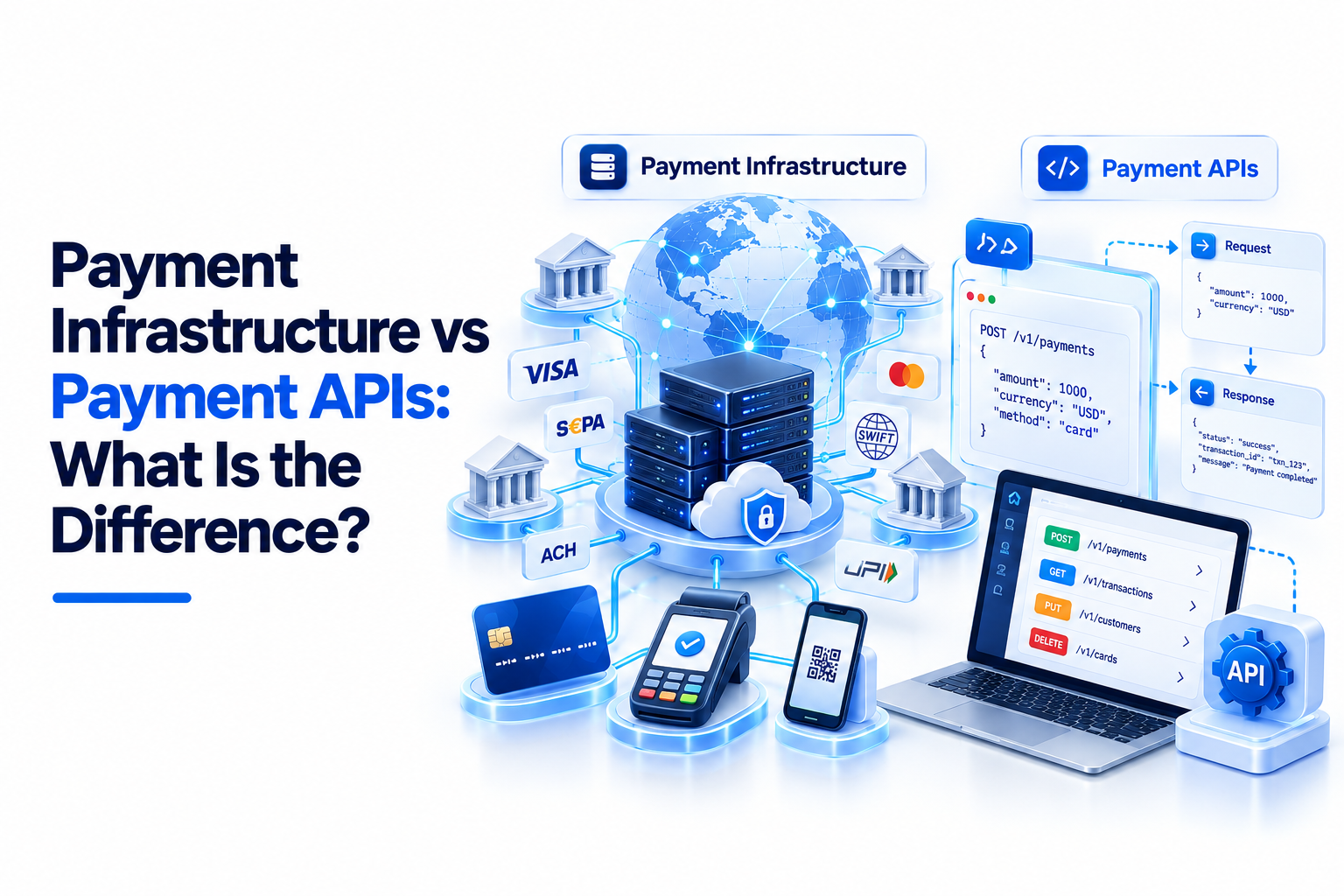
Businesses today need more than a way to accept payments. They may also need to issue cards, manage accounts, process payouts, handle currency conversion, and track transactions across different systems. Understanding the difference between payment infrastructure and payment APIs helps businesses choose the right technology for these needs. Although the two terms are closely connected, they do not mean the same thing. Payment infrastructure provides the underlying capabilities, while payment APIs allow businesses to connect with and use those capabilities.
What Is Payment Infrastructure?
Payment infrastructure is the technology and systems that support financial operations. Depending on the provider, it can include payment processing connections, card issuing, virtual accounts, international transfers, payouts, currency conversion, transaction monitoring, and settlement workflows. For example, a business operating internationally may need to collect funds, convert currencies, send payouts, and reconcile transactions. Payment infrastructure can bring these capabilities together into a more connected operational setup. The exact services available depend on the provider, supported markets, and business requirements.
What Are Payment APIs?
Payment APIs are interfaces that allow software applications to communicate with payment services. They enable developers to integrate financial functions into websites, applications, platforms, and internal systems without building every capability from scratch. Payment APIs can support functions such as initiating transactions, issuing cards, retrieving payment statuses, and receiving transaction updates through webhooks. For example, a business platform can use an API to initiate a payout and receive status updates as the transaction progresses. This helps connect payment activity with its own customer experience and operational workflows.
Payment Infrastructure vs Payment APIs: Key Differences
Payment Infrastructure Provides the underlying payment capabilities and systems May include payment networks, processing, accounts, cards, and payouts Supports the broader payment operation Depends on the provider's technology and service coverage Payment APIs Connect applications to available payment capabilities Provides programmatic access to specific functions Helps automate and integrate payment workflows Depends on available endpoints, documentation, and integration options In simple terms, payment infrastructure is what supports the payment operation, while payment APIs help software interact with it. APIs are often one part of a wider payment infrastructure solution.
Why Do Businesses Need Both?
Businesses that rely on disconnected financial systems may face manual processes, inconsistent transaction data, and limited visibility across payment operations. A connected infrastructure with suitable APIs can help businesses: Automate payment workflows: Reduce repetitive manual tasks by connecting applications to payment services. Improve transaction visibility: Use payment statuses and webhooks to track activity. Connect financial functions: Integrate cards, accounts, payments, and payouts where supported. Support business growth: Add capabilities as operational needs evolve. Simplify reconciliation: Bring transaction data into internal systems for easier review. However, APIs alone do not guarantee a complete payment solution. Businesses still need to assess service availability, security, compliance responsibilities, settlement arrangements, and integration requirements.
How NetPay Connects Payment Capabilities
NetPay offers payment infrastructure and API-based solutions designed to help businesses connect financial operations. Its offerings include global payments, global payouts, virtual accounts, and card issuing capabilities. Through available integrations, businesses can explore ways to connect payment flows with their own applications and operational systems. For example, global payment and payout workflows can help businesses manage international money movement, while card issuing APIs can support card creation and lifecycle management. Businesses evaluating NetPay should review the specific APIs, supported markets, currencies, and services relevant to their requirements
How to Choose the Right Solution
Before choosing a payment infrastructure provider or API solution, consider your business needs. Start by identifying which financial functions you need, such as collections, payouts, card issuing, or currency conversion. Then assess the provider's coverage, API documentation, integration complexity, security controls, pricing, and support. If you need only one payment function, a focused API integration may be sufficient. If your business requires several connected financial capabilities, a broader payment infrastructure solution may be more suitable.
Conclusion
Payment infrastructure and payment APIs serve different but complementary roles. Infrastructure provides the systems and capabilities that support financial operations, while APIs allow applications to access and integrate those services. For growing businesses, understanding this difference makes it easier to evaluate technology providers, reduce integration complexity, and build payment workflows that can evolve with business needs.
What is the main difference between payment infrastructure and payment APIs?
Payment infrastructure supports the underlying financial operations, while payment APIs allow applications to interact with specific payment services.
Are payment APIs part of payment infrastructure?
Yes. APIs are often a component of payment infrastructure, providing programmatic access to payment functions and transaction data.
Can a business use payment APIs without building its own payment infrastructure?
Yes. A business can integrate APIs offered by an external provider instead of building every payment capability itself. The available functions depend on the provider.
What should businesses look for in a payment API provider?
Important factors include API documentation, supported payment functions, integration requirements, security, transaction updates, pricing, and technical support.
How does NetPay support payment integration?
NetPay offers API-based solutions across payment and card-related capabilities. Businesses should review its available services and technical documentation to determine the right fit.

The NetPay247 team writes about card issuing, Virtual IBANs, cross-border payments and building products on embedded finance infrastructure.



Leave a reply
Your email address will not be published. Required fields are marked *