
Short answer
Learn how businesses can manage compliance across global payment networks using KYC, KYB, AML monitoring, transaction controls, APIs, and reconciliation.
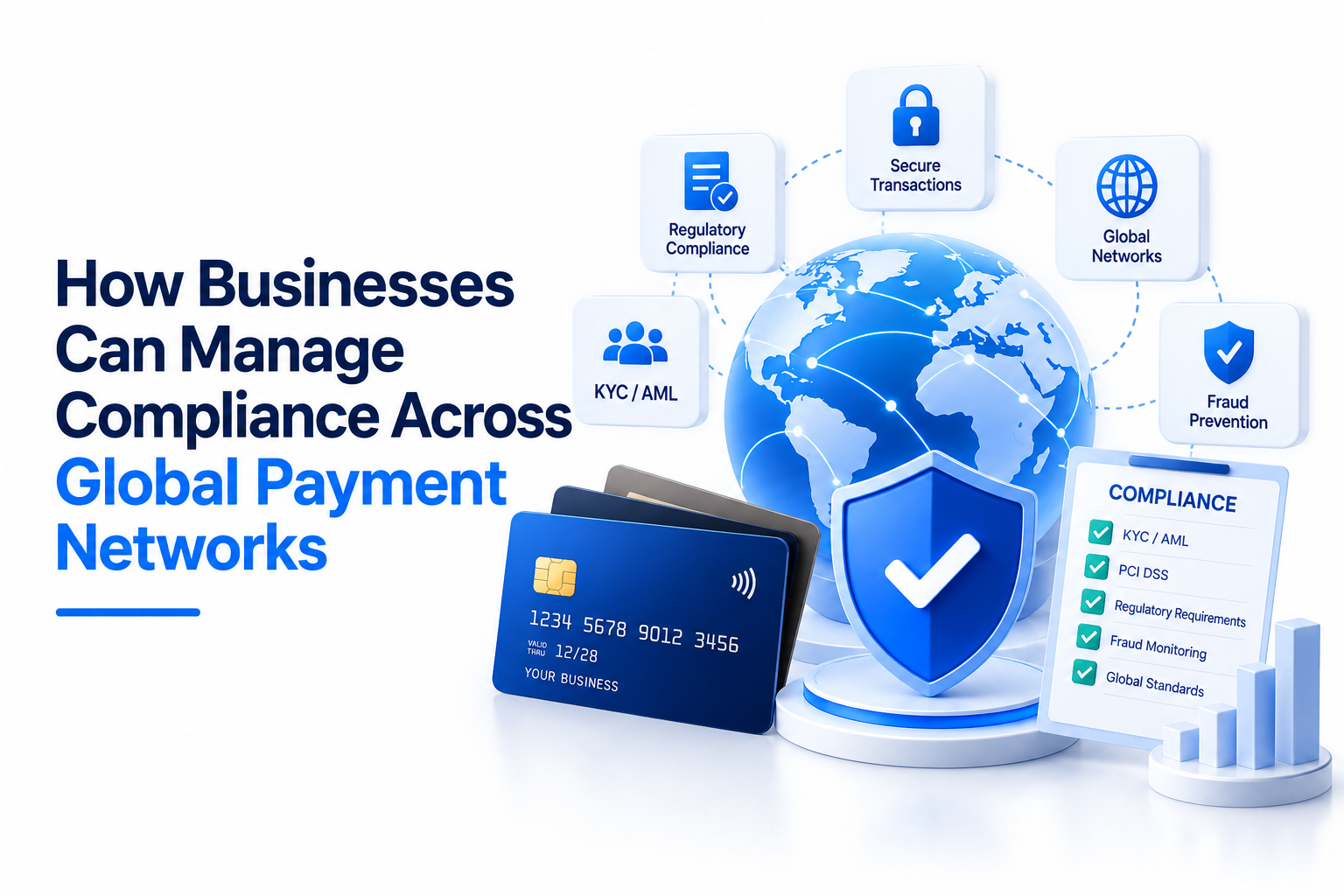
Global payments allow businesses to collect, hold, convert, and send money across different countries and currencies. But as payment activity becomes more international, compliance becomes an important part of managing the payment operation. A business may need to verify customers, monitor transactions, manage payment data, identify unusual activity, and maintain appropriate records. The challenge becomes greater when payments move through different currencies, countries, and payment rails. This is why businesses need global payment compliance processes that are connected to their payment infrastructure rather than handled separately.
Why Compliance Matters in Global Payments
Cross-border payments involve multiple parties, currencies, payment rails, and regulatory requirements. Depending on the business model and jurisdictions involved, companies may need processes for customer verification, business verification, transaction monitoring, sanctions screening, fraud controls, and record keeping. A fragmented approach can make it difficult to maintain visibility across transactions. Instead, businesses can build compliance into the payment workflow: Onboard → Verify → Transact → Monitor → Review → Report This creates a more structured approach to managing payment activity.
KYC and KYB at the Start of the Payment Journey
Compliance begins before money moves. KYC (Know Your Customer) helps businesses verify individuals, while KYB (Know Your Business) focuses on business verification. These processes can help payment providers understand who is using the financial service and assess the relevant risks. For global payment platforms, onboarding and verification workflows need to work alongside the payment infrastructure. NetPay describes KYC/KYB onboarding as part of its payment and card issuing infrastructure, with structured verification workflows before services are activated.
Build Compliance Into Payment Workflows
Compliance becomes easier to manage when it is connected to the actual payment flow. For example: Customer Onboarding | KYC/KYB Verification | Payment Initiation | Risk & Transaction Monitoring | Payment Processing | Status Tracking | Reconciliation & Reporting This approach can reduce disconnected processes and give businesses a clearer view of what happens throughout a transaction's lifecycle. NetPay's global payment infrastructure supports collections, currency conversion, international transfers, API connectivity, webhooks, and reconciliation through a connected platform.
Maintain Strong Access Controls
Compliance is also connected to who can access payment information and operational tools. Businesses should consider role-based access so that employees only receive the permissions required for their responsibilities. For example, a finance employee may need reporting access, while an operations user may need payment management capabilities. Not every employee needs access to every payment function. NetPay states that its infrastructure uses role-based access controls alongside KYC/KYB, AML monitoring, and PCI DSS Level 1 certified systems.
How NetPay Supports Global Payment Infrastructure
NetPay provides infrastructure for businesses that need to collect, convert, hold, and move money internationally. Its global payments platform supports payment activity across 150+ countries, settlement across 35+ currencies, SEPA and SWIFT rails, FX conversion, APIs, webhooks, and reconciliation. Its broader security and compliance infrastructure includes KYC/KYB onboarding, AML transaction monitoring, role-based access controls, and PCI DSS Level 1 certified systems. This allows businesses to connect payment operations and compliance-supporting processes through a more unified infrastructure.
Final Thoughts
Managing compliance across global payment networks is not simply about adding a verification step before a transaction. It requires a connected approach that covers: Verify → Monitor → Control → Track → Reconcile When compliance-supporting processes are connected to payment infrastructure, businesses can gain better visibility into transactions and create more structured operational workflows. For companies operating internationally, the right global payment infrastructure can provide the technology needed to support these processes while businesses remain responsible for understanding and meeting the regulatory requirements applicable to their activities. NetPay combines global payment capabilities with compliance and security workflows to help businesses build payment operations that are designed for international activity.
What is global payment compliance?
Global payment compliance refers to the processes businesses use to meet applicable regulatory and risk requirements when sending, receiving, or managing payments across countries and payment networks.
Why is KYC important for global payments?
KYC helps businesses verify customers and understand who is using their payment services. It can form an important part of a broader compliance and risk-management process.
What is AML transaction monitoring?
AML transaction monitoring involves reviewing payment activity for patterns or transactions that may require further investigation under applicable anti-money-laundering requirements.
How do APIs help with payment compliance?
APIs can connect payment infrastructure with internal compliance, finance, and operational systems, allowing businesses to automate workflows and exchange payment information.
Why are payment webhooks useful?
Webhooks can provide real-time transaction and status updates to a business's systems, helping with monitoring, record keeping, and reconciliation.

The NetPay247 team writes about card issuing, Virtual IBANs, cross-border payments and building products on embedded finance infrastructure.


Leave a reply
Your email address will not be published. Required fields are marked *